


Real Wartime Relics: The Story of a V1 Flying Bomb
Before I launch into the main feature of this week's blog, a quick update on our COBI delivery which showed up just before 2pm today (Friday). We shipped as many Spitfire pre-orders as we could but our Royal Mail collection also arrived early which didn't help! All remaining pre-orders and back-orders will be dispatched first thing Monday. Along with the new Spitfire and Tiger 131, the shipment also included a restock of the V1 flying bomb which is the main feature of this blog.
Finally, don't forget, we will be at Yeovil Model Show in Taunton on Sunday if you fancy a fun day out.
Warmest wishes,
Zoë
Finally, don't forget, we will be at Yeovil Model Show in Taunton on Sunday if you fancy a fun day out.
Warmest wishes,
Zoë
A V1 flying bomb shot down over Kent: A story behind the COBI model
Sometimes, the most fascinating pieces of history are found in the most unexpected places. Duncan P. discovered these remarkable V1 flying bomb relics at his place of work on an estate near Woodchurch, Kent, where three V1s came down during the Second World War.
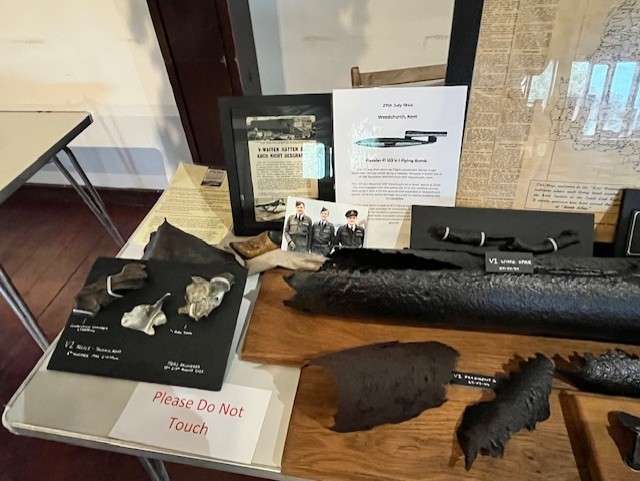
One particular incident stood out. On the night of 27 July 1944, a V1 was shot down by New Zealand pilot Flight Lieutenant James Hugh McCaw of No. 486 Squadron RNZAF, operating from RAF Newchurch. The timing, historical records and location of the recovered fragments all point to this being the flying bomb brought down by McCaw that night.
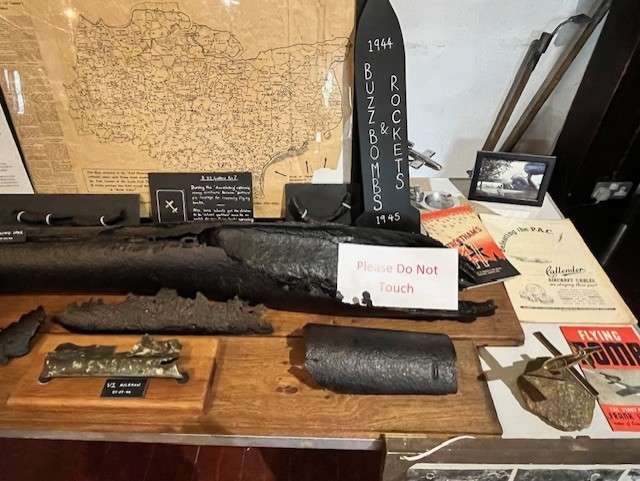
Among the items Duncan recovered are a section of aileron retaining its original paint, a four-foot length of wing spar, a wing spar clip and a V1 wing stay, along with other fragments of the weapon.
These fascinating relics form part of Duncan’s private collection, but their story reaches beyond his own interest in military history. He regularly takes them to 1940s events and local schools, helping bring the history of the Second World War to life for new generations.
Alongside the surviving wreckage, we also have a COBI V1 Flying Bomb model that helps illustrate the design of this distinctive German weapon — connecting a construction-brick recreation with the real remains of a flying bomb destroyed over the Kent countryside more than 80 years ago.
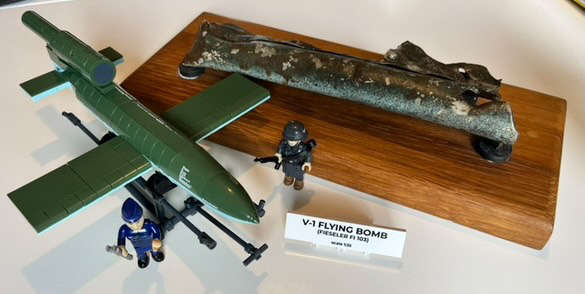
Among the surviving pieces are:
-
A section of aileron, retaining some of its original paint.
-
A four-foot section of wing spar, part of the structure that supported the wing.
-
A wing spar clip, another component of the wing assembly.
-
A V1 wing stay, along with other fragments of the weapon.
The surviving paint on the aileron is particularly striking. More than 80 years after the flying bomb came down, it offers a glimpse of the original finish of a weapon that was once part of a major campaign against Britain.
The wing spar and its associated fittings also reveal something of the engineering behind the V1. Although often described as a flying bomb or missile, it had the basic structure of an aircraft, with wings, control surfaces and a fuselage built around its guidance system and explosive payload.
These fragments help turn a familiar outline from history books into something much more immediate: a physical object that flew over the Kent countryside during the war.
A Night-Time Interception Over Kent
At approximately 22:30 on 27 July 1944, Flight Lieutenant James Hugh McCaw took off from RAF Newchurch in his Hawker Tempest V fighter, serial number EJ523. Serving with No. 486 Squadron RNZAF, McCaw was part of the Allied effort to defend Britain against Germany’s increasingly destructive V1 flying bomb campaign.
Around 22:50, he encountered a V1 in the Ashford area. After opening fire, he succeeded in bringing the flying bomb down. It crashed and exploded near Woodchurch, causing damage to local buildings, according to local Air Raid Precautions (ARP) records. Fortunately, no casualties were reported.
McCaw and his fellow pilots were engaged in a dangerous and demanding task. The V1 was unmanned, travelled at high speed and carried a substantial explosive warhead. Intercepting one required pilots to close in on a flying weapon that could detonate at any moment.
The Dreaded Doodlebug
The V1, officially designated the Fieseler Fi 103, became one of the most recognisable weapons of the Second World War. Known as the Doodlebug or buzz bomb, it was an early form of cruise missile, powered by a pulsejet engine mounted above its fuselage.
The engine produced a distinctive buzzing sound that became a terrifying feature of life for people living beneath its flight path. As the RAF Museum explains, the engine’s vibration led to the infamous ‘buzz-bomb’ noise, which would suddenly stop when the V1 was over its target.
The weapon relied on a relatively simple guidance system, using a gyroscope to control its flight and a preset air-distance mechanism to determine when it should dive towards its target.
The first V1s were launched against London in June 1944. Over the following months, thousands were directed towards Britain, bringing destruction to homes, streets and communities across the south of England.
The defence effort relied on anti-aircraft guns, barrage balloons and fighter aircraft. Hawker Tempests proved particularly effective at intercepting V1s thanks to their speed and performance at low altitude.
RAF Newchurch, in Kent, became a key base for this campaign. According to the Newchurch Village website, aircraft operating from the airfield destroyed 638 V1 flying bombs between June and September 1944.
Discovering the Wreckage Near Woodchurch
The story of McCaw’s interception does not end with the explosion. Fragments of the flying bomb have since been recovered near the impact site, offering a tangible connection to that night in 1944.
The COBI V1 Flying Bomb Model
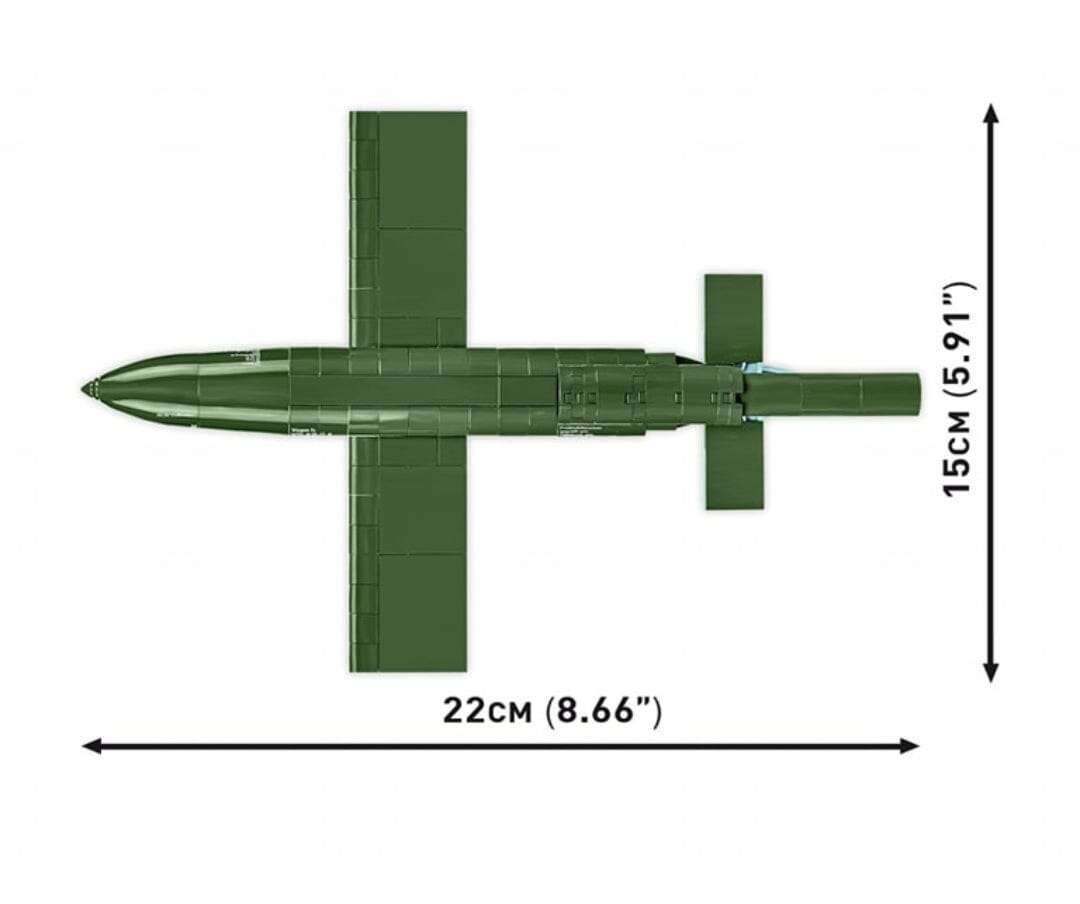
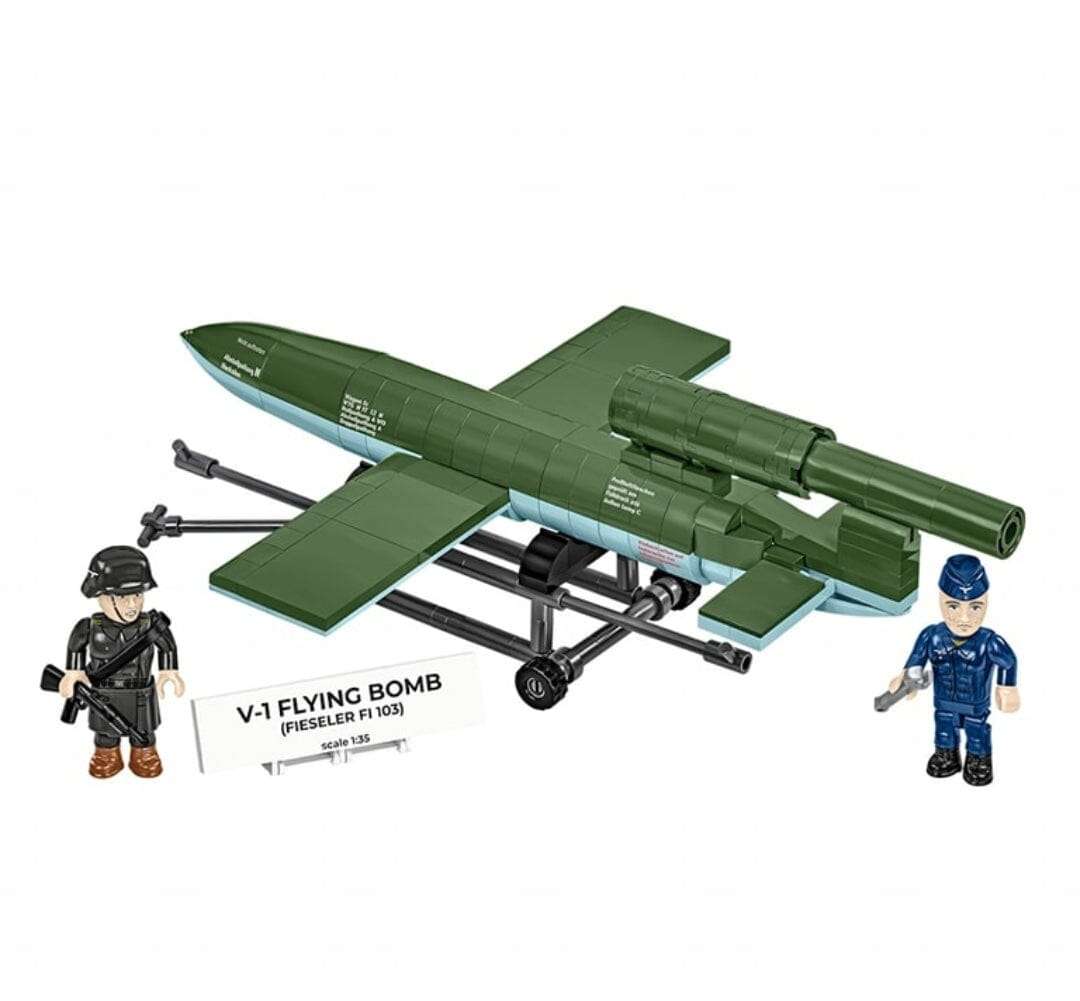
The COBI V1 Flying Bomb (Fieseler Fi 103), set COBI-3135, recreates this distinctive weapon in construction bricks.
The 1:35-scale model contains 265 pieces and measures approximately 22 cm long, with a wingspan of 15 cm. It includes the characteristic pulsejet engine, a transport trolley, a display plaque and two figures representing a Luftwaffe guard and a mechanic.
The model offers an accessible way to explore the design of the V1, from its long, streamlined fuselage to the unusual engine mounted above the body.
Seeing the COBI model alongside genuine V1 fragments makes the history especially interesting. The model helps illustrate the complete shape of the weapon, while the surviving aileron, spar and fittings show the real materials and components left behind when one was destroyed.
It is a reminder that behind every historical model lies a much bigger story — of engineering, wartime innovation and the people whose lives were affected by these machines.


A small piece of history that survived
The V1 brought fear and destruction to communities across southern England, but the interception near Woodchurch ended without reported loss of life. The surviving wreckage provides a rare physical link to that particular event and to the airmen who worked to protect Britain from the attacks.
For anyone interested in the Second World War, these relics offer something that photographs and written accounts cannot quite replicate: the opportunity to examine pieces of the actual weapon involved.
Combined with the COBI V1 Flying Bomb model, they help bring this chapter of local and military history into sharper focus — connecting a small corner of the Kent countryside with one of the most significant developments in wartime weapons technology.
Further Reading
Check out this 11 minute documentary by Imperial War Museum which provides a fascinating overview of the weapon, the people who built them and how/why they came into existence.